T with caron
Caron
Ť uppercase Czech or Slovak letter
COPY & TYPE / T WITH ACCENT
Copy T with a caron, comma below, cedilla, dot above, dot below, line below, or circumflex below. Use the labels and language notes to select the exact character.
Click a character, then paste with Ctrl+V or ⌘V.
CHARACTER GUIDE
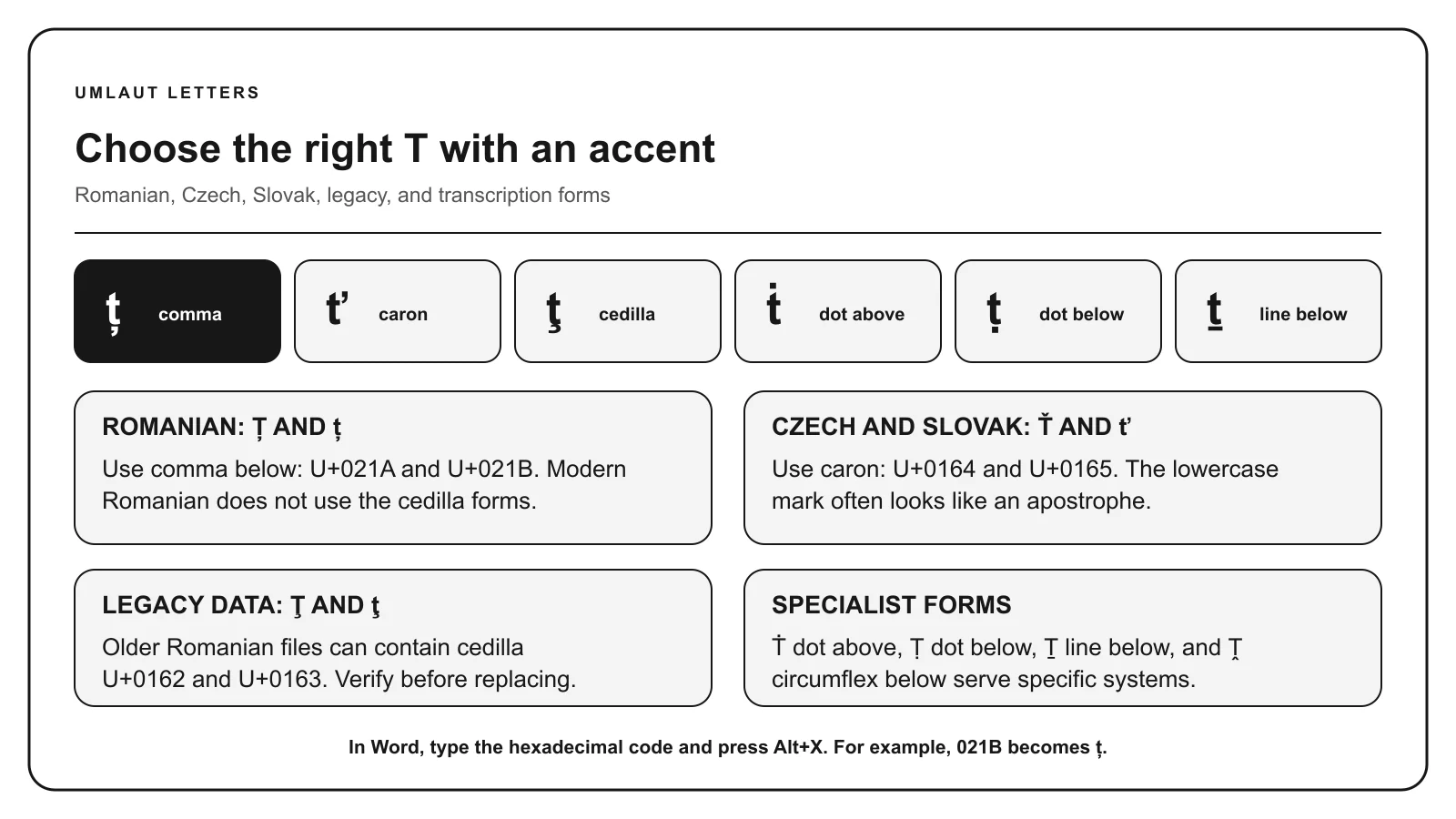
The T family contains language letters and specialist transcription forms. Romanian uses T with comma below, Czech and Slovak use T with caron, and older Romanian data may contain the visually similar T with cedilla.
Caron
Ť uppercase Czech or Slovak letter
Caron
ťava camel in Slovak
Comma below
ȚARĂ country in uppercase Romanian
Comma below
țară country in Romanian
Cedilla
Ţ legacy Romanian data form
Cedilla
ţ legacy Romanian data form
Dot above
Ṫ uppercase dotted T
Dot above
ṫ historical or scholarly form
Dot below
Ṭ uppercase transliteration form
Dot below
ṭ retroflex T in transliteration
Line below
Ṯ uppercase transliteration form
Line below
ṯ transliteration character
Circumflex below
Ṱ uppercase specialist form
Circumflex below
ṱ specialist orthographic form
Diaeresis
ẗ specialist transliteration form
KEYBOARD METHODS
ț has no dependable legacy Alt sequence across ordinary Windows configurations. Copy it, use Character Map, enable a language keyboard, or enter its Unicode value in Microsoft Word.
Use the numeric keypad for listed Alt codes, not the number row. A listed code may depend on Windows and the active character set.
The Mac US or ABC layout does not provide one shortcut for the complete T family. Use Character Viewer, add the appropriate Romanian, Czech, or Slovak input source, or copy the exact character. The lowercase caron on ť may look like a small apostrophe beside the letter.
Shortcuts described here assume the US or ABC input layout. Another selected layout can assign different keys.
Touch and hold T on the on-screen keyboard. Keep your finger down, slide to the character you need, and release. Switch to uppercase before holding the key for a capital letter.
The available characters depend on your keyboard and enabled languages. Add a relevant language keyboard if the required form does not appear.
In Microsoft Word for Windows, type a hexadecimal value without U+, then press Alt + X. For example, type 021B and convert it to ț. Select only the code before converting if another letter or number comes immediately before it.
For repeated Romanian, Czech, or Slovak writing, enable that language keyboard. In Microsoft Word, enter the hexadecimal Unicode value and press Alt+X, such as 021B for ț, 0165 for ť, or 1E6D for ṭ.
CHARACTER REFERENCE
| Letter | Mark | Unicode | Windows Alt | HTML named | HTML decimal |
|---|---|---|---|---|---|
| Ť | Caron | U+0164 | Not standard | Ť | Ť |
| ť | Caron | U+0165 | Not standard | ť | ť |
| Ț | Comma below | U+021A | Not standard | Not listed | Ț |
| ț | Comma below | U+021B | Not standard | Not listed | ț |
| Ţ | Cedilla | U+0162 | Not standard | Ţ | Ţ |
| ţ | Cedilla | U+0163 | Not standard | ţ | ţ |
| Ṫ | Dot above | U+1E6A | Not standard | Not listed | Ṫ |
| ṫ | Dot above | U+1E6B | Not standard | Not listed | ṫ |
| Ṭ | Dot below | U+1E6C | Not standard | Not listed | Ṭ |
| ṭ | Dot below | U+1E6D | Not standard | Not listed | ṭ |
| Ṯ | Line below | U+1E6E | Not standard | Not listed | Ṯ |
| ṯ | Line below | U+1E6F | Not standard | Not listed | ṯ |
| Ṱ | Circumflex below | U+1E70 | Not standard | Not listed | Ṱ |
| ṱ | Circumflex below | U+1E71 | Not standard | Not listed | ṱ |
| ẗ | Diaeresis | U+1E97 | Not standard | Not listed | ẗ |
Paste the character itself into normal text. HTML entities belong in HTML source. Unicode labels use hexadecimal notation, while HTML decimal entities and Windows Alt codes use decimal numbers.
MEANING & SPELLING
Modern Romanian spelling uses Ț and ț with a comma below. Czech and Slovak use Ť and ť with a caron. T with dot below is common in scholarly transliteration, where the dot can identify a retroflex consonant.
Ţ and ţ with cedilla are not the preferred modern Romanian characters. They occur in legacy text because older standards and fonts sometimes substituted a cedilla for the required comma below. Preserve them only when faithfully reproducing historical or legacy data.
Ŧ and ŧ are T with stroke, not T with an accent, so they are outside this copy grid. Þ and þ are thorn, a separate letter. A similar silhouette does not make either character part of the accented T family.
There is a precomposed lowercase ẗ, but Unicode does not provide a matching precomposed uppercase T with diaeresis. If a specialist standard requires uppercase T plus diaeresis, it may use a combining sequence, which contains two code points.
Ț and ț are U+021A and U+021B. The legacy cedilla forms Ţ and ţ are U+0162 and U+0163. Check the code point when a font makes the marks look nearly identical.
COMMON QUESTIONS
Ț and ț are T with comma below. They are letters in the Romanian alphabet and should be used instead of the older cedilla forms in modern Romanian text.
Ť and ť are T with caron. They are used in Czech and Slovak. The caron on lowercase ť is commonly drawn as a compact apostrophe-like mark.
Type 021B and press Alt+X for lowercase ț. Type 021A and press Alt+X for uppercase Ț.
The first has a cedilla and the second has a comma below. Older Romanian computing often used the cedilla form, but current Romanian text uses the comma-below character.
No. Most extended T characters have no dependable legacy Alt sequence. Use Word Alt+X, Character Map, a matching language layout, or copy and paste.
No. Ŧ and ŧ have a stroke through the letter rather than a diacritical mark, so they are modified letters outside this accent-focused set.
Sources: Unicode Latin Extended-A, Unicode Latin Extended-B, Unicode Latin Extended Additional, EU Publications Office Latin letters, Microsoft Support.