C with cedilla
Cedilla
ÇA that in uppercase French
COPY & TYPE / C WITH CEDILLA
Select Ç for uppercase or ç for lowercase. Copy the letter, then paste it into a name, word, document, or message.
Click a character, then paste with Ctrl+V or ⌘V.
CHARACTER GUIDE
Ç and ç are C with cedilla. The cedilla is the small hook beneath the letter. This character appears in French, Portuguese, Catalan, Turkish, and other languages.
Cedilla
ÇA that in uppercase French
Cedilla
garçon boy in French
KEYBOARD METHODS
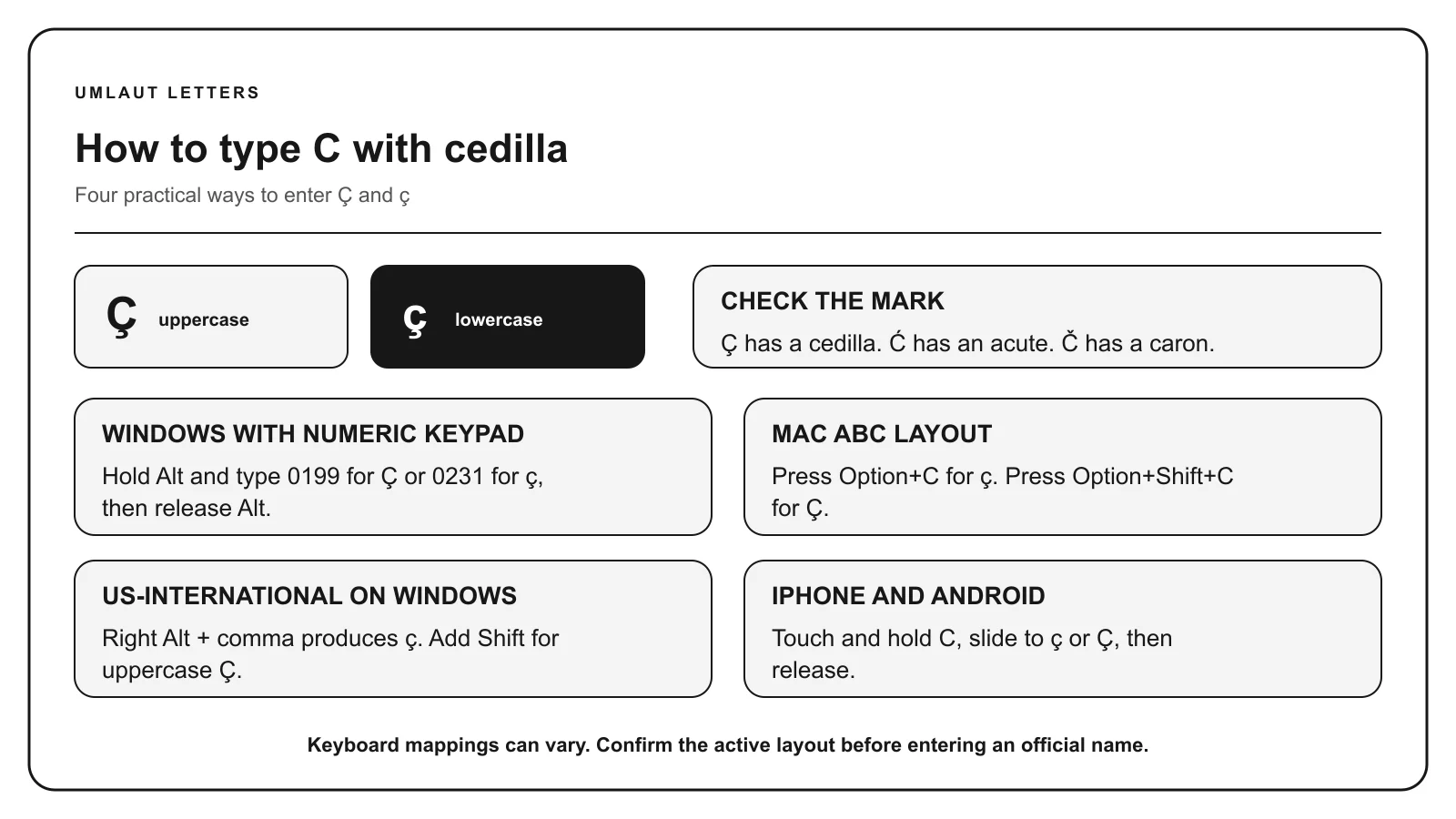
Turn Num Lock on. Hold Alt, enter 0231 on the numeric keypad, and release Alt to produce ç.
Use the numeric keypad for listed Alt codes, not the number row. A listed code may depend on Windows and the active character set.
On the US or ABC layout, press Option + C for ç. Hold Shift while pressing Option + C for Ç. You can also hold the C key and choose the cedilla form from the accent menu.
Shortcuts described here assume the US or ABC input layout. Another selected layout can assign different keys.
Touch and hold C on the on-screen keyboard. Keep your finger down, slide to the character you need, and release. Switch to uppercase before holding the key for a capital letter.
The available characters depend on your keyboard and enabled languages. Add a relevant language keyboard if the required form does not appear.
In Microsoft Word for Windows, type a hexadecimal value without U+, then press Alt + X. For example, type 00E7 and convert it to ç. Select only the code before converting if another letter or number comes immediately before it.
With the US-International keyboard enabled, apostrophe followed by C can produce ç. A French, Portuguese, or Turkish keyboard may provide a direct or layout-specific method.
CHARACTER REFERENCE
| Letter | Mark | Unicode | Windows Alt | HTML named | HTML decimal |
|---|---|---|---|---|---|
| Ç | Cedilla | U+00C7 | Alt+0199 | Ç | Ç |
| ç | Cedilla | U+00E7 | Alt+0231 | ç | ç |
Paste the character itself into normal text. HTML entities belong in HTML source. Unicode labels use hexadecimal notation, while HTML decimal entities and Windows Alt codes use decimal numbers.
MEANING & SPELLING
French uses ç before a, o, and u in words such as ça and garçon. Portuguese uses it in words such as açúcar, Catalan uses it in façana, and Turkish treats ç as a letter with its own pronunciation.
The cedilla changes how C is read, but the exact sound and spelling rule depend on the language. Preserve it in names and original-language text.
If a form cannot accept ç, follow its instructions. Replacing ç with c may be a technical fallback, but it is not always the exact spelling.
The cedilla sits below the C. Ć has an acute accent above it, while Č has a caron above it. These are different Unicode characters used in different languages.
COMMON QUESTIONS
It is called a cedilla. The full character is C with cedilla, written as Ç in uppercase and ç in lowercase.
Copy it from this page, press Option + C on a Mac, hold C on a phone, enable a suitable keyboard layout, or type 00E7 followed by Alt+X in Microsoft Word.
Modern standard Spanish does not normally use ç, although it appeared historically. The character remains current in languages including French, Portuguese, Catalan, and Turkish.
Yes. Ç is the uppercase form of ç, and the cedilla stays attached to the letter.
Sources: Unicode Latin-1 Supplement, Unicode Latin Extended-A, Unicode Latin Extended Additional, Apple Support, Microsoft Support.