PRACTICAL CHARACTER GUIDE
Why German umlauts have two dots
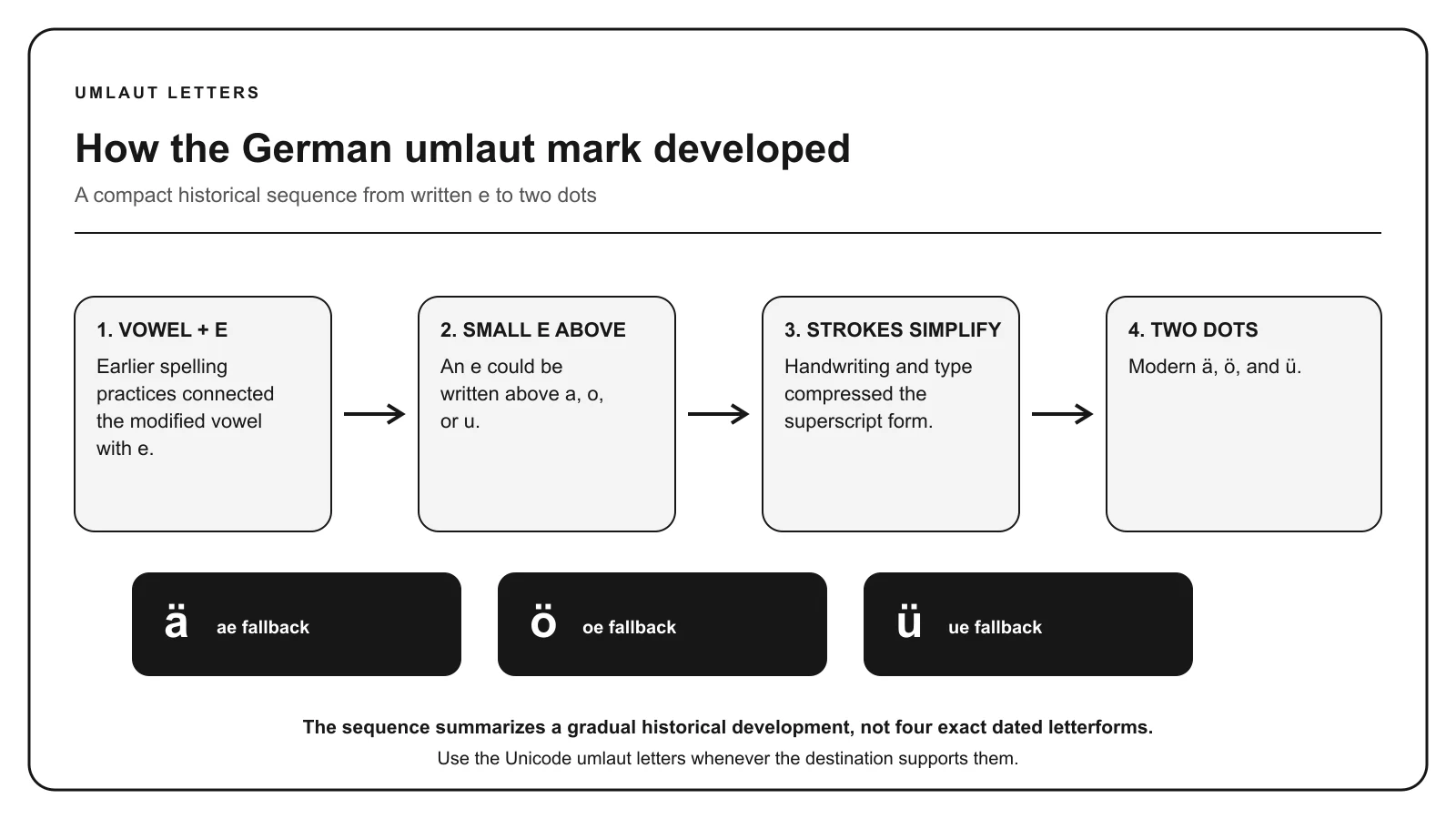
The dots over German ä, ö, and ü developed from an earlier way of writing an e with the vowel. The modern mark records a historical spelling practice and identifies vowels that remain distinct in German words.
01
The written mark is connected to a vowel change
The linguistic term umlaut refers to a historical sound change in which a vowel was influenced by a vowel, often i or j, in a following syllable. Related word forms can preserve the relationship, as in German singular and plural patterns where a plain vowel corresponds to an umlaut vowel.
Modern readers encounter umlaut as both a linguistic concept and an orthographic feature. The letters ä, ö, and ü are not decorative versions of a, o, and u. Replacing or omitting the dots can change spelling, pronunciation, and sometimes meaning.
02
A small e was once written above the vowel
In older German writing, an e could be written above a, o, or u to represent the modified vowel. Over time, the superscript e was simplified in handwriting and type. The small strokes eventually developed into the familiar pair of dots.
This history also explains the standard technical fallbacks ae, oe, and ue when the umlaut character cannot be used. The fallback reflects the older association with e. It is more accurate than simply deleting the dots and leaving a, o, or u.
03
Printing and handwriting shaped the modern form
Letterforms change when scribes, printers, and readers repeat them across centuries. A compact mark above the vowel was easier to integrate than a fully formed superscript letter. Different type and handwriting traditions used small strokes before two dots became conventional.
The precise appearance still depends on the font. Dots can be round, square, heavy, or lightly separated. Those design differences do not create different Unicode characters. German ü remains U+00FC in each typeface.
04
Why only A, O, and U take the German umlaut
Standard German uses umlaut forms of a, o, and u: ä, ö, and ü, with uppercase Ä, Ö, and Ü. German does not create parallel ordinary umlaut letters from every vowel. The writing system reflects the language’s historical vowel patterns and spelling conventions.
The two dots can occur over other letters in other languages. French ë and ï commonly carry a diaeresis, while Swedish treats ä and ö as alphabet letters with its own ordering and pronunciation. Appearance alone does not identify the linguistic function.
05
Umlaut and diaeresis share Unicode characters
Unicode uses stable technical names such as LATIN SMALL LETTER U WITH DIAERESIS. German text still correctly calls ü an umlaut letter. Spanish gü and German gü can contain the same encoded character while the two-dot mark has a different linguistic explanation.
Language context supplies the label and function. You do not need to convert the character when moving between those languages. Preserve the Unicode letter and mark the language of the surrounding text where software needs pronunciation or accessibility context.
06
How to preserve an umlaut in modern text
Use ä, ö, or ü whenever the system accepts Unicode. For a technical environment that truly cannot represent them, German spelling practice uses ae, oe, or ue. Names can follow established personal or legal spellings, so consult the source rather than applying a blanket conversion.
For typing once, copy the verified character. For regular German writing, add a German keyboard layout. The German keyboard tool is useful for a short passage when changing the system layout is inconvenient.
Continue with the right reference
Sources: Goethe-Institut: German language history appendix, Deutschland.de: German umlauts.